

Table of Contents
ToggleSomething Massive Is Shifting in Marketing (And You Need to Know About It)
Remember when everyone said social media would kill traditional marketing? Or when mobile was going to change everything? Yeah, I heard those predictions too. Got tired of them, actually. Every few months there’s supposedly some groundbreaking thing that’ll revolutionize the industry.
But what’s happening with AI right now? This one’s real. I’m not exaggerating.
Started noticing it maybe 18 months back. Clients were asking weird questions. “Can we automate this?” “What about using ChatGPT for our content?” At first I thought it was just another trend. People get excited, try something new, then go back to normal when reality hits.
Except nobody went back to normal. The questions kept coming. The tools kept getting better. And suddenly I’m sitting here watching AI do things that would’ve taken my team weeks to accomplish. We’re in what people are calling the Agentic Revolution – and no, that’s not just fancy marketing speak. It’s actually an accurate description of what’s going down.
Here’s why I’m writing this today. Taha Tauqeer is putting together a session at NED University’s National Incubation Center. I’ve known about Taha’s work for a while – he’s trained something like 500+ professionals, worked with over 100 brands. The guy knows his stuff. When he says there’s something important happening in digital marketing, I pay attention. You probably should too.
Event Information
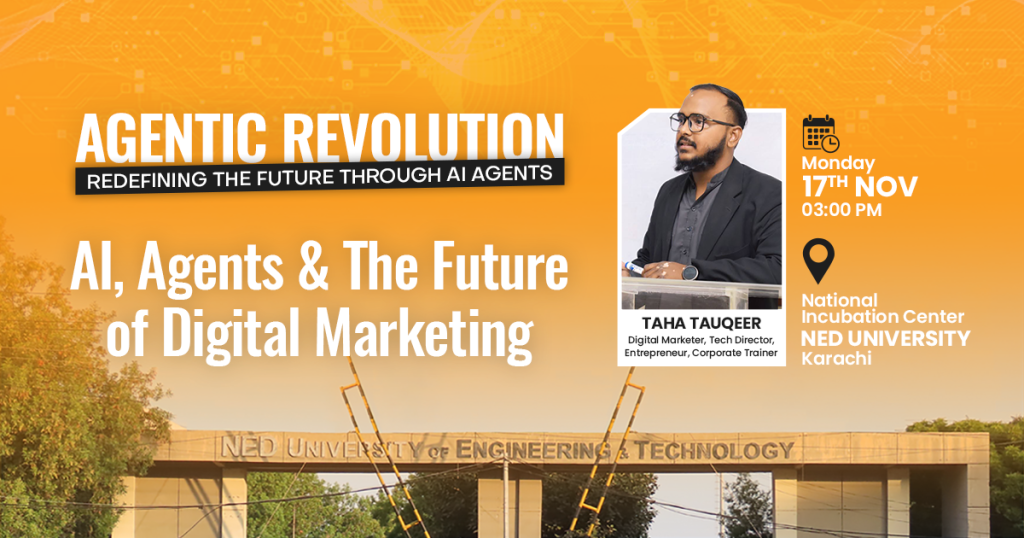
Event Title: Agentic Revolution, Redefining the Future Through AI Agents
What They’re Covering: AI, Agents & The Future of Digital Marketing
Date: Monday, November 17th, 2025
Time: 3:00 PM
Location: National Incubation Center, NED University, Karachi
Speaker: Taha Tauqeer (Digital Marketer, Tech Director, Entrepreneur, Corporate Trainer)
Registration Link: https://forms.gle/kqPCBa94ubavDo328
Understanding the Agentic Revolution
Your typical day as a marketer probably looks something like this: Wake up, check analytics, respond to client messages, create content, schedule posts, monitor campaigns, adjust budgets, analyze competitors, put out fires, repeat. By Friday you’re exhausted. By Sunday evening you’re already dreading Monday.
We’ve had AI tools for a while now. They help with scheduling. Some basic automation. Maybe they write a draft or two. But here’s the thing – you still had to manage everything. Tell the tool exactly what to do. Check its work. Fix mistakes. It was helpful, sure, but not exactly revolutionary.
AI agents are a whole different animal. These systems can actually think through problems on their own. They plan campaigns. Make adjustments based on performance data. Learn what works for your specific audience. Optimize continuously without waiting for you to notice something’s wrong.
Saw this in action a few weeks ago. A colleague showed me their email marketing setup. The AI agent was managing subscriber segmentation, personalizing content for different groups, testing subject lines automatically, adjusting send times based on engagement patterns. My colleague just set the overall strategy and goals. The agent handled everything else. Results? Better than when they managed it manually.
That’s not supposed to be possible yet. But it is. And it’s getting more sophisticated every month.
Some marketers are figuring this out quickly and running with it. Others are still trying to do everything the old way. Guess which group is burning out and which group is thriving?
What You’ll Actually Learn at This Session
Taha and Muhammad Tufail Ahmed Khan (he’s the technical expert joining for this session) aren’t planning some generic presentation. They’re covering specific, practical stuff you can actually use.
The Real Mechanics Behind AI
Most people use ChatGPT or similar tools without understanding what’s happening behind the scenes. How does it generate responses? Why does it sometimes give brilliant answers and other times completely miss the mark? What’s machine learning actually doing?
Understanding the fundamentals helps you use these tools way more effectively. It’s the difference between randomly trying stuff and knowing exactly how to get the results you want.
Making Sense of Large Language Models
GPT, Gemini, Claude – these names are everywhere now. But what are they? How do they process information? Why can they write coherent content but struggle with basic arithmetic?
Muhammad’s handling this section since he’s the programmer. From what I’ve heard, he’s really good at explaining technical concepts without making your brain hurt. The goal is understanding how these models work so you can apply them to real marketing challenges – content creation, ad copy, strategy development, customer communication.
AI Agents in Actual Marketing Situations
This is probably the section I’m most interested in. Real examples , Real brands and Real results.
What does AI-powered SEO actually look like in practice? How do you let an AI agent manage email campaigns without disaster? Can these systems create social content that doesn’t sound generic and robotic? What about customer service? Analytics? Budget optimization?
You’ll see case studies from brands already implementing this stuff successfully. Not theoretical possibilities – actual implementation with real data.
Cutting Through the Tool Noise
There are thousands of AI marketing tools out there right now. New ones launch every week. Most are trash. Some are okay but overpriced. A small percentage are genuinely useful.
Taha’s been testing these tools with actual clients and real budgets. He knows which ones deliver on their promises and which ones are just riding the AI hype wave. That kind of curated insight saves you an enormous amount of time and money.
Because testing tools yourself is expensive. And time-consuming. And frustrating when most of them don’t work as advertised.
Where This Is All Headed
AI development moves at an absurd pace. What seems impossible today might be standard in six months.
We’re looking at trends that are emerging right now: Complete workflow automation. Personalization that actually feels personal rather than creepy. Ethical considerations that need addressing. How human creativity and strategic thinking fit into an increasingly automated landscape.
Understanding what’s coming helps you prepare instead of just reacting when changes hit your industry.
About the Speakers
Taha Tauqeer isn’t some consultant who’s never run a real campaign. He’s trained over 500 professionals. Worked with more than 100 brands on their digital transformation. Most importantly – he’s dealt with the messy reality of marketing. Tight budgets. Skeptical clients. Campaigns that didn’t work. All the stuff that doesn’t make it into case studies.
When Taha talks about integrating AI into marketing workflows, he’s speaking from actual experience. Not theory. Not what should work in an ideal world. What actually works when you’re dealing with real constraints and real expectations.
Muhammad Tufail Ahmed Khan brings the technical depth. He’s a programmer and AI enthusiast who understands the architecture and logic behind these systems. What makes him valuable for this session is his ability to translate technical concepts into practical applications. Most programmers can’t do that. Most marketers can’t understand the technical side deeply enough. Muhammad bridges that gap.
Who Should Show Up
Anyone working in digital marketing who wants to stay relevant. That’s the honest answer.
Digital marketers who keep hearing about AI but feel overwhelmed trying to understand it. Content creators spending way too much time on tasks that could probably be streamlined. Entrepreneurs trying to compete with companies that have massive budgets. Developers interested in business applications of their technical skills. Students trying to figure out where the opportunities are in this changing landscape.
If your work involves digital marketing in any way, you need this information. Even if you’re skeptical about AI – and healthy skepticism is good – understanding what’s possible helps you make better strategic decisions.
Why This Matters More Than You Think
Being real with you – marketers who understand these AI tools are moving ahead fast. Better jobs. Bigger clients. Higher quality output in less time. People who keep saying “I’ll learn this later” are finding themselves falling behind.
Not trying to fear-monger. Just telling you what I’m observing in the industry right now.
You don’t need to become a programmer. You don’t need to understand every technical detail. But you do need to grasp the capabilities, limitations, and practical applications of these tools. Otherwise you’re competing with a significant disadvantage.
After attending this session, you’ll understand how AI is restructuring marketing at a fundamental level. You’ll know how to use LLMs for actual marketing work. You’ll have actionable knowledge, not just concepts. Plus you’ll connect with other professionals navigating this same transition.
How to Register (Do It Now)
Limited space available. NIC can only fit so many attendees. Based on interest so far, this will fill up.
Register here: https://forms.gle/kqPCBa94ubavDo328
Don’t wait on this. Just take two minutes right now and register. You’ll thank yourself later.
Final Thoughts
Marketing’s future isn’t humans versus AI. It’s humans working alongside AI to accomplish things neither could do independently.
What humans do well: creativity, strategic thinking, understanding emotional nuance, building relationships, making judgment calls in ambiguous situations.
What AI does well: processing massive data sets, identifying patterns, optimizing at scale, executing repetitive tasks flawlessly, working continuously without fatigue.
Combining both? That’s where the real advantage lies.
The Agentic Revolution represents a genuine shift in how marketing operates. You can learn about it now while there’s time to adapt and experiment. Or learn about it later when you’re scrambling to catch up. Your call.
Show up at NIC NED University on November 17th. Ask tough questions. Challenge the ideas. Be skeptical if you want. All good. Taha Tauqeer and Muhammad Tufail Ahmed Khan will show you what’s actually happening with AI in marketing right now – separating reality from hype.
This is one of those moments where attendance matters. Don’t skip it because you’re busy or keep putting it off. Register now. Block the time. Show up. Simple.
The marketers who understand this stuff early will have a massive advantage. Might as well be you.
FAQs About Agentic AI
Q1: What does being agentic mean?
Being agentic refers to having the power to make choices and take actions independently. It describes a person or system that acts with self-direction and purpose instead of relying solely on outside instructions.
Q2: What does agentic era mean?
The agentic era represents a new chapter in artificial intelligence where systems can think, plan, and act autonomously. It’s the stage where AI moves beyond simple automation to self-driven decision-making.
Q3: What is meant by agentic AI?
Agentic AI is an advanced form of artificial intelligence capable of reasoning, planning, and executing tasks on its own. Unlike traditional AI, it can take initiative and adapt its actions based on goals and context.
Q4: What is the evolution of agentic AI?
Agentic AI has evolved from basic algorithms to intelligent agents that can understand, analyze, and act independently. It began with rule-based logic, advanced through machine learning, and is now moving toward full autonomy and self-learning systems.
Q5: What are the 7 stages of AI?
The seven main stages of AI development are: Rule-Based AI, Context Awareness, Machine Learning, Deep Learning, Autonomous Systems, Artificial General Intelligence (AGI), and Artificial Superintelligence (ASI). Each level adds greater intelligence and independence.
Q6: Is Tesla agentic AI?
Tesla’s self-driving software demonstrates elements of agentic AI because it can interpret surroundings and make driving decisions in real time. However, it’s still semi-autonomous and needs human oversight for safety.
Q7: What is the difference between AI and agentic AI?
Regular AI responds to data and commands, while agentic AI can act proactively, make decisions, and pursue objectives on its own. In short, traditional AI reacts, agentic AI takes initiative.
Q8: Will agentic AI replace humans?
Agentic AI is designed to assist rather than replace humans. It will automate complex and repetitive work, but creativity, emotional intelligence, and ethical reasoning will continue to rely on human input.
Q9: Who is leading in agentic AI?
Top innovators in agentic AI include OpenAI, Google DeepMind, Anthropic, and Microsoft. These companies are developing advanced autonomous systems that can think, reason, and operate with minimal human direction.